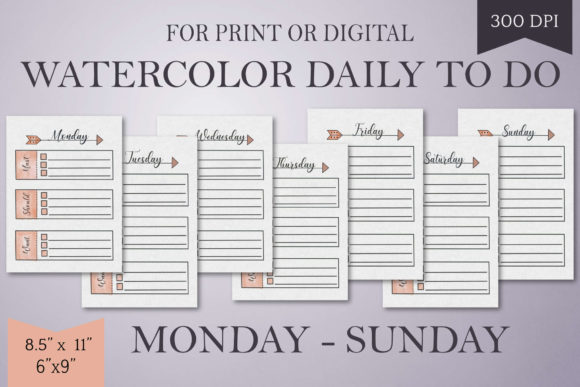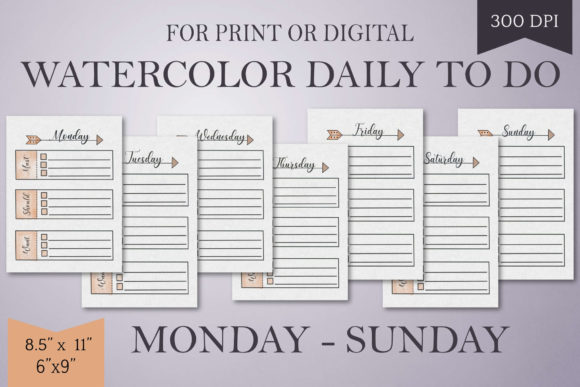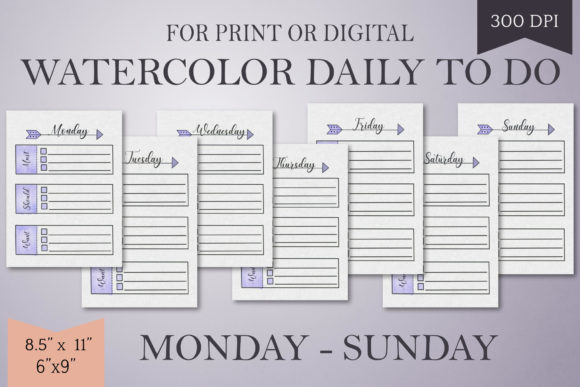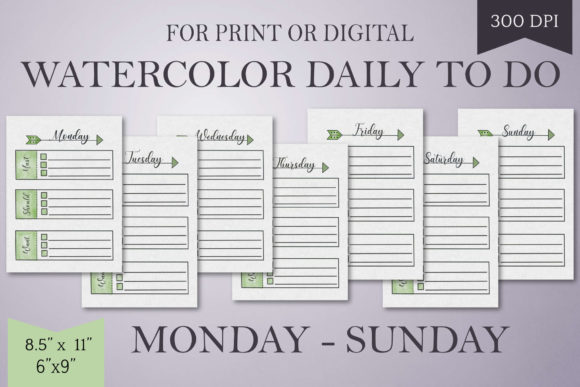
Blue Watercolor Daily To Do List Mon-Sun
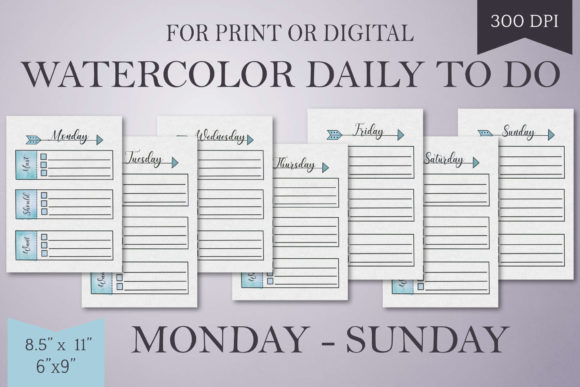
Finding the balance between strict organization and creative freedom is a constant challenge for professionals and creators alike. Standard grid planners often feel too rigid, while blank notebooks lack the necessary structure to keep projects moving forward. The Blue Watercolor Daily to Do List-Mon-Sun bridges this gap by combining functional task management with an organic, hand-drawn aesthetic. This specific layout offers a refreshing alternative to sterile productivity tools, providing a textured paper background and soft watercolor accents that make the act of planning feel less like a chore and more like a mindful ritual.
For those in the Print on Demand (POD) or Amazon Kindle Direct Publishing (KDP) space, this template serves as a versatile foundation. However, its value extends far beyond commercial publishing. Whether you are a freelancer managing client deliverables, an educator organizing lesson plans, or a hobbyist tracking personal goals, the integration of artistic elements with practical lists creates a user experience that encourages consistency. The design acknowledges that productivity is not just about checking boxes; it is about maintaining a mental state where work feels sustainable and visually pleasing.
Design Characteristics That Enhance Usability
The primary strength of the Blue Watercolor Daily to Do List-Mon-Sun lies in its deliberate visual hierarchy. Unlike generic templates that rely solely on bold lines and heavy borders, this design uses color and texture to guide the eye without causing visual fatigue. The watercolor accents provide a sense of calm, which is particularly beneficial for users who experience anxiety when facing long task lists. The textured paper background mimics the tactile experience of high-quality stationery, adding a layer of sophistication that digital screens often lack.
Functionally, the layout is optimized for the "Must, Should, Want" prioritization method. This framework forces users to distinguish between urgent obligations, important but non-urgent tasks, and aspirational activities. By physically separating these categories within a Monday-through-Sunday structure, the template prevents the common mistake of treating all tasks as equally critical. For KDP publishers, this built-in methodology adds intrinsic value to the book. It transforms a simple notebook into a guided productivity tool, which can significantly improve customer satisfaction and reviews.
Commercial Applications for POD and KDP Publishers
For entrepreneurs building a low-content or medium-content publishing business, asset versatility is key to profitability. This template is engineered specifically for the demands of platforms like Amazon KDP. It comes in two essential sizes: US Letter and 6x9 inches, both formatted with appropriate margins to prevent content bleed during printing. The inclusion of grayscale-optimized versions ensures that the watercolor effects translate beautifully even when printed in black and white, preserving the design's integrity across different price points and printing options.
- Mix and Match Flexibility: Publishers are not locked into a single format. You can duplicate pages to create a full-year planner, combine them with journaling prompts, or intersperse them with habit trackers to create a unique hybrid product.
- Digital and Physical Hybrid Models: The PDF interior pages serve dual purposes. Use them as the interior file for a physical paperback and simultaneously sell the digital version as a printable or iPad planner insert, maximizing revenue streams from a single design asset.
- Brand Consistency: The distinct blue watercolor theme allows for easy branding. Creators can develop a suite of complementary products—notebooks, wall art, and digital downloads—that share a cohesive visual identity, encouraging repeat purchases.
When evaluating this template for commercial use, consider your target niche. The hand-drawn look appeals strongly to demographics that value aesthetics alongside utility, such as teachers, nurses, artists, and wellness coaches. Positioning your product as a "mindful planner" or "creative organizer" rather than a generic to-do list can help capture this specific audience segment.
Personal Productivity and Creative Brainstorming
Beyond its commercial viability, the Blue Watercolor Daily to Do List-Mon-Sun excels as a personal productivity instrument. The weekly spread format allows for macro-level planning while still accommodating daily specifics. This is ideal for professionals who need to see their entire week at a glance but also require space to break down complex projects. The open nature of the watercolor design leaves room for brainstorming and ideation. Unlike rigid corporate planners, the artistic margins invite doodling, note-taking, and free association, which can spark creativity during planning sessions.
Educators and students find particular value in the uncluttered layout. The separation of "Must, Should, Want" aligns well with academic scheduling, helping learners manage coursework, extracurriculars, and self-care without burnout. For freelancers and marketers juggling multiple clients, the visual distinction between days helps compartmentalize workflows. Instead of a continuous, overwhelming stream of tasks, the week is broken into digestible, aesthetically framed segments. This psychological segmentation reduces cognitive load and makes starting the workday feel more manageable.
Implementing Digital Planners and Printables
In an increasingly paperless world, the adaptability of this template for digital use cannot be overstated. When imported into apps like GoodNotes, Notability, or Xodo, the high-resolution PDF maintains crisp edges and vibrant colors. Digital planner users often seek out designs that replicate the warmth of analog stationery, and the textured paper effect satisfies this desire perfectly. Hyperlinks can easily be added to the Monday-Sunday tabs or specific sections, transforming the static PDF into a fully interactive navigation system.
For those selling printables on platforms like Etsy, offering multiple size variations increases the product's appeal. A customer might want the US Letter size for desk planning but prefer the 6x9 version for a travel journal. Providing both options within a single purchase reduces friction and adds perceived value. Additionally, because the design relies on watercolor textures rather than complex vector illustrations, it prints exceptionally well on home printers. This is a crucial consideration for the printable market, where customers expect professional results without commercial-grade equipment.
Practical Considerations for Selection and Use
While the Blue Watercolor Daily to Do List-Mon-Sun is highly versatile, successful implementation requires attention to detail. If using this for KDP, always order a proof copy before publishing. Watercolor gradients can sometimes appear darker or muddier in print than on screen, especially in grayscale. Testing ensures the contrast remains sufficient for writing legibility. For digital users, verify that the PDF resolution is at least 300 DPI to prevent pixelation when zooming in on tablets.
Creators should also consider the binding type if producing physical books. The 5mm margin specification mentioned in the product details is generally safe for standard KDP paperback binding, but if you plan to add extensive annotations or use thicker paper stocks via other POD providers, double-check gutter requirements. The goal is to ensure the watercolor accents remain visible and the writing space remains accessible near the spine.
Ultimately, the effectiveness of any planning tool depends on alignment with the user's workflow. This template works best for those who view planning as a holistic practice rather than a purely mechanical one. Its strength is in its ability to soften the edges of productivity, making organization feel like an act of self-care. Whether you are publishing a best-selling planner or simply trying to organize your own creative business, the blend of structure and artistry offers a compelling solution to modern organizational challenges.