Evaluating the Printable Priority Planning Matrix-Ltr for Personal and Commercial Use
Effective task management often requires moving abstract thoughts into a concrete visual format. The Printable Priority Planning Matrix-Ltr serves this specific function by providing a structured framework to organize tasks based on urgency and importance. Designed in standard Letter size, this resource is distinct because it functions as both a personal productivity tool and a commercial asset for creators in the Print on Demand (POD) and Amazon Kindle Direct Publishing (KDP) spaces. Understanding the dual nature of this matrix is essential for determining whether it aligns with your organizational needs or business inventory requirements.
Defining the Resource and Its Core Function
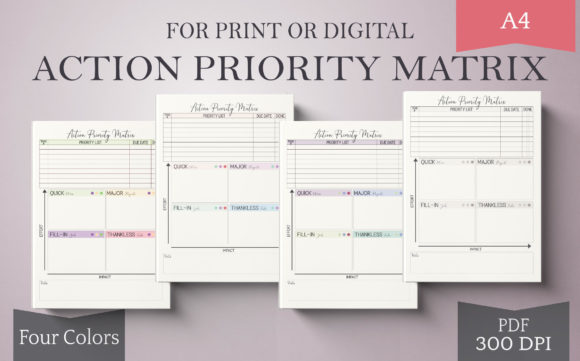
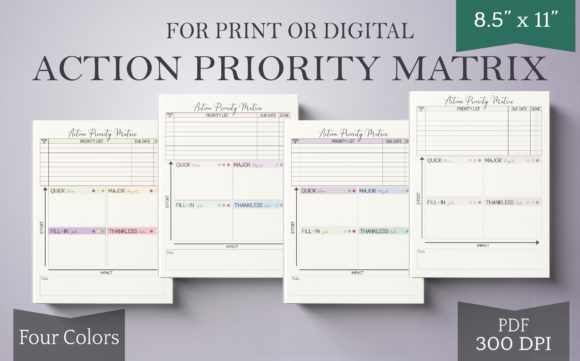
The Printable Priority Planning Matrix-Ltr is a digital PDF interior page designed to facilitate decision-making through visualization. At its core, it utilizes the Eisenhower Matrix concept, dividing tasks into four quadrants to help users distinguish between what is urgent, what is important, what can be delegated, and what should be eliminated. Unlike generic to-do lists, this matrix forces a cognitive evaluation of each item before it is recorded.
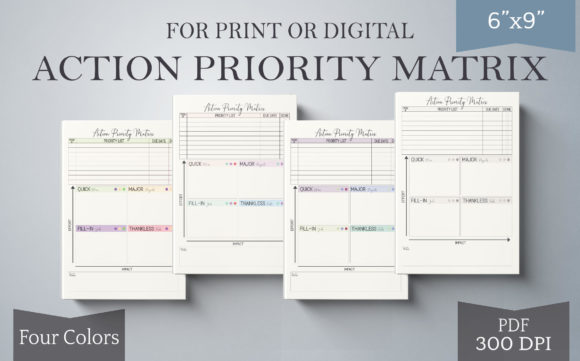
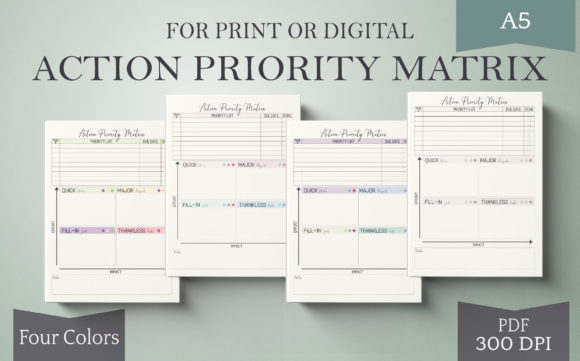
Technically, the resource is provided as a high-resolution 300 DPI PDF in Letter dimensions. It includes four distinct color variations, allowing for thematic consistency or functional color-coding. Crucially, it also includes a grayscale version. This technical specification is significant for two audiences: individuals printing at home who wish to conserve ink, and KDP publishers whose primary medium is black-and-white paperback interiors. The inclusion of multiple files supports versatility, enabling users to duplicate pages, mix templates, or integrate the matrix into larger compiled planners.
Applications for Personal Productivity
For individual users evaluating this matrix as a standalone printable or digital planner insert, the primary value lies in cognitive offloading. When facing mental clutter, the act of categorizing tasks into a visual grid reduces decision fatigue. The four-color option allows users to associate specific hues with different projects or energy levels, which can enhance engagement for visual learners.
However, potential users must consider their preferred planning style. This matrix is an evaluative tool, not merely a recording tool. It is most effective for individuals who struggle with prioritization rather than those who simply need a checklist. If your challenge is remembering tasks, a standard list may suffice. If your challenge is distinguishing high-value activities from busy work, the Printable Priority Planning Matrix-Ltr offers a necessary structural constraint. The Letter size format is also a practical consideration; it provides ample writing space compared to A5 or pocket sizes, making it suitable for desk-based planning rather than mobile capture.
Commercial Viability for POD and KDP Creators
A significant portion of interest in this resource stems from its utility as a commercial interior. For entrepreneurs building low-content or medium-content books, acquiring high-quality, pre-formatted interiors is a matter of efficiency. The Printable Priority Planning Matrix-Ltr is marketed with commercial rights, allowing it to be used in KDP paperbacks, eBooks, or sold as standalone digital printables.
When evaluating this asset for business use, creators should assess the saturation of the niche. Priority matrices are a staple in the productivity category. To make this specific product viable, it typically cannot stand alone. The ability to "mix and match" is the key differentiator here. Successful KDP products often combine this matrix with daily logs, weekly reviews, goal-setting worksheets, and habit trackers. The availability of four colors and a grayscale version allows publishers to create multiple editions of the same book or offer a premium color version alongside a standard black-and-white edition.
Furthermore, the 300 DPI resolution is non-negotiable for print quality. Blurry lines or pixelated text result in negative reviews and returns. Users verifying this product for commercial application should confirm that the PDF layers are flattened or secured appropriately to prevent editing issues during the upload process to platforms like Amazon or Etsy.
Benefits and Strategic Advantages
The primary benefit of this specific matrix package is flexibility. By providing both color and grayscale options, it bridges the gap between digital planning and physical publishing. Digital planner users can utilize the colored versions for hyperlinked PDFs on tablets, while print publishers can utilize the grayscale version to keep printing costs low and royalties high.
Additionally, the Letter size format aligns with standard US paper standards, reducing friction for American customers purchasing physical prints or books. For creators, having a ready-made, professional-grade interior accelerates time-to-market. Instead of spending hours designing a grid and testing margins, creators can focus on cover design, keyword research, and marketing. The permission to duplicate and modify means the asset can scale across multiple products without additional licensing fees.
Tradeoffs and Limitations
Despite its utility, the Printable Priority Planning Matrix-Ltr has limitations that must be weighed. As a template, it is static. It does not include automated calculations, reminders, or integrations with software like Notion or Trello. Users seeking dynamic project management will find this insufficient. It is strictly an analog-style interface, even when used digitally.
For commercial users, the tradeoff is exclusivity. Because this is a purchasable template, other sellers may have access to the exact same interior. Relying solely on this matrix without adding unique value—such as proprietary instructional content, custom covers, or supplementary niche-specific pages—can lead to commoditization. Furthermore, while the matrix helps prioritize, it does not teach the methodology. Publishers may need to add introductory content explaining how to use the matrix effectively to differentiate their book from competitors using similar templates.
Situational Fit and Alternatives
This resource is a strong fit for specific scenarios. It is ideal for KDP publishers expanding a productivity line who need consistent, high-quality interiors quickly. It is also suitable for coaches or consultants who want to provide clients with a branded worksheet without hiring a graphic designer. For individuals, it fits those who prefer tactile planning and need a dedicated space to triage daily tasks.
Conversely, alternatives may be worth considering in other contexts. If you require team collaboration or real-time updates, digital project management software is superior. If you are a KDP publisher targeting international markets, an A4 or A5 size might be more appropriate than the Letter size offered here. Additionally, if your audience requires guided journaling rather than structural planning, a lined journal or prompt-based workbook would serve better than a blank matrix.
Making the Final Decision
Determining whether the Printable Priority Planning Matrix-Ltr is the right choice depends on aligning its specifications with your end goal. For personal use, evaluate whether the visual quadrant method solves your specific prioritization bottleneck. For commercial use, calculate whether the time saved in design justifies the cost, and verify that the license terms match your distribution strategy.
Ultimately, this matrix is a foundational component rather than a complete solution. Its value is realized when integrated into a broader system, whether that system is a personal productivity routine or a diversified catalog of published works. By understanding its technical attributes, intended applications, and inherent limitations, users can make an informed decision that supports either their organizational clarity or their business growth objectives.