KDP Interiors Mazes Puzzle Book: Streamlining Your Low-Content Publishing Workflow
Hello and welcome to my Lafuma Design Studio. If you are navigating the competitive landscape of Amazon KDP, you understand that speed and quality must coexist. Creating high-engagement activity books from scratch is time-consuming, which is why many publishers turn to pre-made interiors. Specifically, a Corridor Mazes Interior offers a unique visual style that stands out against generic dot-to-dot or simple line mazes. However, acquiring a KDP Interiors Mazes Puzzle Book digital product is only the first step. The difference between a profitable listing and a rejected manuscript often lies in how you handle, verify, and implement these ready-to-upload assets.
This guide focuses on practical application for entrepreneurs, educators, and freelancers who want to boost their business without sacrificing quality. We will explore how to correctly utilize this specific 100-page resource while avoiding common pitfalls that plague low-content creators.
Understanding the Asset Specifications
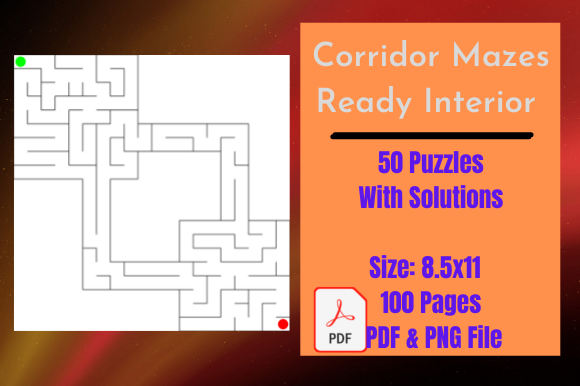
Before uploading anything to KDP, you must have a granular understanding of what you have purchased. This specific digital download is designed for immediate use, but "ready to upload" assumes your project settings match the file specifications exactly. This interior package includes two PDF files and one PNG file, comprising 100 pages total. The structure is deliberate: 50 individual maze pages followed by 50 corresponding solution pages.
The dimensions are fixed at 8.5 x 11 inches in black and white. A frequent error occurs when creators attempt to force these files into non-standard trim sizes like 8x10 or 6x9 without adjusting margins. Because this is a corridor-style maze, resizing can distort the path widths, making them unsolvable or visually unappealing. Always set your KDP book size to 8.5 x 11 before importing. Furthermore, verify that the PDF is flattened. While the inclusion of a PNG file suggests editability, ensure you are using high-resolution software if you choose to convert or modify the design. Low-quality conversions result in pixelated lines that trigger KDP’s automated quality warnings.
Common Mistakes with Pre-Made Maze Interiors
Even experienced publishers make oversight errors when integrating third-party interiors. Recognizing these issues early saves days of rework and protects your account health.
Neglecting Bleed and Margin Safety Zones
The most critical technical aspect of using a pre-formatted KDP Interiors Mazes Puzzle Book is respecting safety zones. Although this interior is formatted for 8.5 x 11, you must confirm whether the PDF includes bleed. Most puzzle books require a no-bleed setting unless the maze paths extend to the very edge of the paper. If you select "Bleed" in KDP options for a no-bleed PDF, your content will shift, potentially cutting off maze entrances or solutions. Conversely, selecting "No Bleed" for a file designed with bleed will create unwanted white borders. Always open the PDF in a viewer with measurement tools to check the distance from the content to the page edge before finalizing your upload.
Overlooking Solution Page Alignment
A functional maze book requires accurate answer keys. With 50 mazes and 50 solutions included, it is tempting to assume they are perfectly sequenced. However, formatting shifts during file merging or conversion can misalign answers. A practical mistake is failing to print a physical proof copy. Digital previews do not always reveal pagination errors. Before publishing, print the entire manuscript or at least spot-check pages 10, 25, and 40 to ensure Maze #10 corresponds to Solution #10. Misaligned solutions lead to negative reviews, which are difficult to recover from in the children’s activity niche.
Ignoring Metadata and Licensing Terms
Digital products come with usage rights. A common misunderstanding is assuming "ready to upload" implies exclusive ownership. Review the license provided by Lafuma Design Studio. Typically, you can publish the interior as part of a compiled book, but you cannot resell the PDF itself or claim the artwork as your original creation. Additionally, avoid using generic titles like "Maze Book for Kids." Since this is a corridor-style maze, leverage that specificity in your metadata. Failing to differentiate your listing through accurate descriptive keywords wastes the potential of this specialized interior.
Strategic Implementation for Better Results
To maximize the value of this digital product, move beyond basic uploading and treat the interior as a foundation for a branded series.
- Customize the Front Matter: Do not leave the first page blank or generic. Add a title page, a copyright page, and an introduction. For kids' maze books, include a "How to Solve" instruction page. This adds perceived value and increases the page count legitimately without altering the core maze files.
- Leverage the PNG File: The included PNG is valuable for marketing. Use it to create A+ Content or social media teasers. Showing potential buyers the actual corridor maze style builds trust and reduces returns. Many publishers skip this step, resulting in lower conversion rates despite having a superior interior.
- Test Print Quality: Corridor mazes rely on clean, crisp lines. If you plan to edit or convert the file using online tools, test the output resolution. Blurry walls frustrate users. Stick to professional-grade PDF editors or high-fidelity converters to maintain the integrity of the black-and-white line art.
Evaluating Quality Before Purchase or Upload
Whether you are evaluating this specific Lafuma Design Studio product or future interiors, adopt a verification checklist. First, assess the complexity consistency. In a 50-maze set, difficulty should progress logically or remain age-appropriate throughout. Sudden spikes in difficulty indicate poor curation. Second, check for variety. Even within corridor mazes, path layouts should differ. Repetitive patterns suggest algorithmic generation without human oversight, which customers notice quickly.
Finally, consider the user experience regarding solutions. Are the solutions small thumbnails or full-size reproductions? This package provides one solution per page, which is excellent for clarity. Some competitors cram four solutions onto a single page to save space, but this reduces usability for parents and educators. Choosing a layout that prioritizes the end-user over page economy is a strategic advantage in the long term.
Making Informed Decisions for Your KDP Business
Utilizing a KDP Interiors Mazes Puzzle Book is a smart efficiency play, but it requires diligence. The goal is to publish a product that feels bespoke, not mass-produced. By verifying dimensions, testing solution alignment, respecting licensing, and customizing the user experience, you transform a standard digital download into a premium offering.
Remember that Amazon’s algorithm favors engagement and satisfaction metrics. A well-executed corridor maze book that solves problems cleanly will outperform a hastily uploaded generic alternative. Take the time to review the PDF and PNG files thoroughly. Use the resources provided by Lafuma Design Studio as intended, and supplement them with your own branding and quality assurance processes. This balanced approach ensures your low-content publishing efforts yield sustainable, professional results that resonate with both algorithms and human readers.