Password Log Book Journal KDP Interiors: Streamlining Your Low-Content Publishing Workflow
Building a sustainable portfolio on Amazon KDP requires more than just uploading generic templates; it demands efficient workflows and high-quality assets that meet specific platform standards. The Password Log Book Journal KDP Interiors serves as a foundational asset for publishers focusing on the utility and organization niche. This digital product is designed to eliminate the technical friction often associated with creating functional journals, allowing creators to move rapidly from concept to live listing. By utilizing a pre-formatted, upload-ready PDF, self-publishers can bypass the repetitive layout phase and focus their energy on cover design, keyword research, and marketing strategy.
In the broader context of a low-content publishing business, this interior file acts as a standardized production unit. Rather than spending hours adjusting margins, gutter sizes, and line spacing for a 120-page manuscript, you acquire a tested asset that integrates seamlessly into your existing catalog. This efficiency is critical for professionals, freelancers, and small business owners who treat KDP as a serious revenue stream rather than a casual hobby. The inclusion of an editable Adobe Illustrator (AI) file further extends the utility of this asset, transforming it from a static template into a flexible base for future product variations.
Technical Specifications and Platform Compatibility
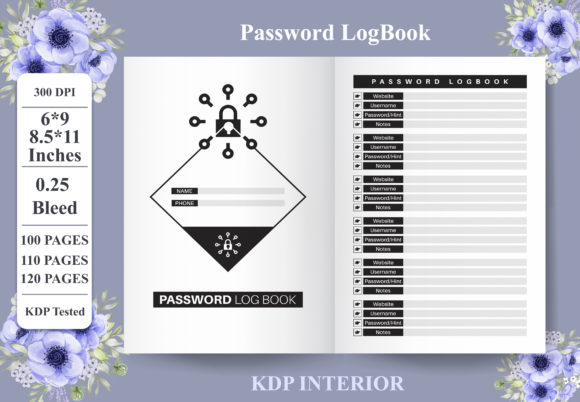
One of the primary failure points in KDP publishing is file rejection due to formatting errors. These Password Log Book Journal KDP Interiors have been rigorously tested on Amazon KDP to ensure quality and compliance. Understanding the specific technical parameters helps prevent upload issues and ensures a professional final product.
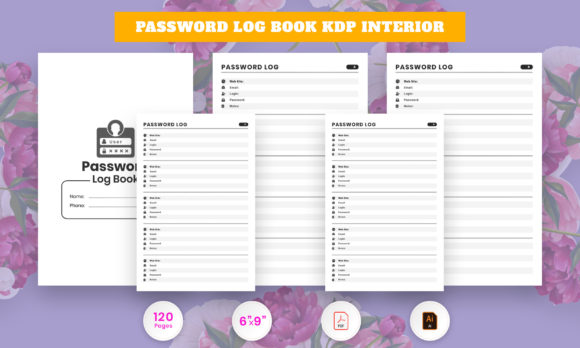
- Trim Size: 6 × 9 inches. This is the industry standard for portable logbooks, offering ample writing space while remaining compact enough for desk or bag storage.
- Page Count: 120 pages. This length strikes an optimal balance between perceived value and printing costs, keeping the paperback price competitive while maintaining healthy royalty margins.
- Bleed Settings: No Bleed. The interior is formatted with appropriate safety margins, ensuring that no content is trimmed during the binding process. This is essential for logbooks where text alignment directly impacts usability.
- Resolution: High-resolution interiors guarantee crisp lines and legible text, which is non-negotiable for functional stationery where users need to write clearly in small fields.
Because these files are pre-validated, they remove the guesswork regarding gutter width and margin safety zones. For publishers managing multiple SKUs, this reliability reduces the time spent troubleshooting proof copies and accelerates the approval timeline.
Integrating the Interior into Your Publishing Pipeline
The true value of this digital download lies in how it fits into your operational workflow. Whether you are launching your first book or scaling an existing brand, the implementation process should be systematic.
Pre-Upload Preparation
Before uploading the PDF to KDP, align the interior with your market research. While the layout is fixed, your metadata and cover design must signal specific use cases. Analyze competitor listings for password logs to identify gaps. Does your target audience prefer alphabetical tabs, categorized sections for different account types, or space for security questions? Although the provided PDF is ready-to-use, understanding the market positioning ensures you pair the interior with the correct keywords and categories. Use this preparation phase to draft your book description and backend keywords so that the moment the file is uploaded, the listing can be completed without delay.
Cover Design Alignment
The interior dimensions dictate your cover template. Since this asset uses a 6 × 9 no-bleed configuration, your cover file must match these specifications exactly. When designing the cover, consider the user experience implied by the interior. A password log suggests privacy, security, and organization. Your cover aesthetics should reflect these attributes through color psychology and typography. Because the interior is already finalized, you can generate the cover template immediately using KDP’s calculator or third-party tools, ensuring perfect spine width calculation based on the 120-page count. This parallel processing—finalizing the cover while the interior is already secured—significantly shortens time-to-market.
Leveraging the Editable AI File
The inclusion of the Editable Illustrator file distinguishes this asset from static PDFs. This file is crucial for long-term portfolio growth and brand consistency. You might use the base PDF for your initial release, but the AI file allows for strategic iteration:
- Niche Adaptation: Modify headers to create specialized versions such as "Senior Citizen Internet Safety Log," "Small Business Account Tracker," or "Crypto Wallet Seed Phrase Journal."
- Branding Elements: Add your publishing imprint logo or subtle watermark to build brand recognition across multiple titles.
- Layout Testing: Experiment with font styles or field arrangements to see if alternative layouts perform better in split testing scenarios.
- Bundle Creation: Combine elements from this logbook with other planners or journals to create comprehensive organizational bundles.
Treating the AI file as a master template rather than a one-off document maximizes your return on investment and supports a scalable content strategy.
Quality Control and User Experience Considerations
For adults aged 20–50, including professionals and productivity-minded users, a password logbook is a functional tool, not a novelty. Usability determines reviews and repeat customers. Even with a tested file, you should conduct a final quality assessment through the lens of the end-user.
Consider the physical interaction with the book. The 6 × 9 size is chosen specifically for portability, but the internal layout must support quick reference. When reviewing the proof copy (digital or physical), verify that the writing lines provide adequate spacing for various handwriting sizes. Ensure that the "Website/URL" fields are wide enough to accommodate modern, lengthy web addresses. Check that the binding gutter does not obscure any entry fields, making the book difficult to use when lying flat. These micro-interactions define the quality perception of your publication.
Furthermore, consider the privacy aspect inherent in this product type. Users purchasing a password log are entrusting sensitive data to this format. Ensuring the paper opacity and print quality meet expectations is part of the value proposition. While you cannot control Amazon's printing variables entirely, starting with a high-resolution, professionally formatted interior minimizes the risk of bleed-through or模糊 text that could compromise the user's sense of security.
Strategic Expansion and Portfolio Management
This Password Log Book Journal KDP Interiors asset supports broader business goals beyond a single SKU. For educators, bloggers, and marketers, it represents a tangible product extension of digital advice. If you teach cybersecurity basics or digital hygiene, this logbook serves as a practical companion resource. Linking to this physical product from blog posts, newsletters, or course materials creates a cohesive ecosystem where digital knowledge meets analog application.
From an inventory management perspective, maintaining consistent trim sizes and page counts across related products simplifies advertising and cross-promotion. When your password logs, address books, and bill trackers all share the same 6 × 9 footprint and visual style, you create a recognizable series. Customers who trust the format of one book are more likely to purchase others in the collection. The editable AI file facilitates this consistency, allowing you to maintain uniform margins, fonts, and header styles across diverse titles.
Efficiency in low-content publishing comes from systematization. By integrating validated, high-quality interiors like this into your workflow, you reduce technical overhead and increase creative output. The result is a more professional catalog, faster launch cycles, and products that genuinely serve the organizational needs of your audience. Whether used as a standalone product or part of a larger suite of productivity tools, this interior provides the reliable infrastructure necessary for sustainable KDP success.