Mastering KDP Interiors: A Guide to High-Resolution Password Tracker Log Books
In the expansive world of Amazon Kindle Direct Publishing (KDP), low-content and medium-content books have emerged as a viable avenue for creators to generate passive income. Among the most practical and consistently in-demand niches is the password tracker log book. As digital security becomes increasingly complex, the need for physical, offline record-keeping has surged. However, success in this competitive market relies heavily on quality. For sellers looking to elevate their portfolio, understanding the technical specifications of premium interiors—specifically those that are high-resolution, print-ready, and formatted correctly—is essential. This guide explores the significance of professional-grade password tracker interiors, breaking down why specific technical standards matter and how they translate to customer satisfaction and sales.
The Enduring Relevance of Physical Password Logs
At first glance, it may seem counterintuitive to sell a physical notebook for storing digital credentials in an era dominated by cloud-based password managers and biometric authentication. However, the password tracker log book serves a distinct purpose that technology cannot fully replicate. For many demographics, particularly seniors or those wary of cloud security breaches, a tangible logbook offers peace of mind. It provides an air-gapped backup system that is immune to hacking, server outages, or forgotten master passwords.
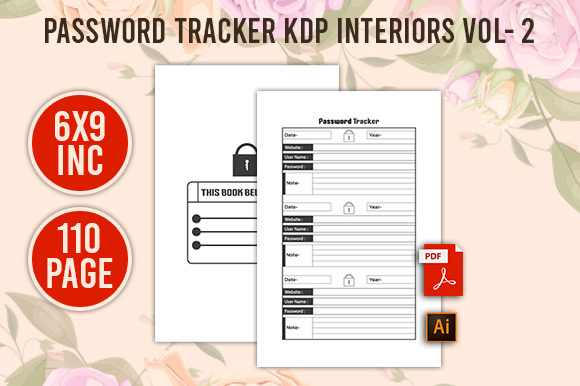
From a business perspective, this creates a stable niche for KDP sellers. Unlike trend-based journals that fade with seasons, password logs are evergreen utility items. They solve a perpetual problem: memory fatigue. When creating interiors for this niche, sellers are not merely designing blank lines; they are engineering a user experience that balances organization with security. The best interiors provide ample space for usernames, passwords, website URLs, security questions, and notes, all arranged in a layout that is intuitive rather than cluttered.
Why Technical Specifications Define Quality
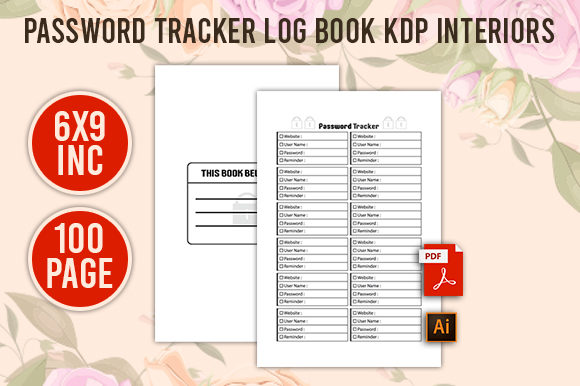
New KDP sellers often make the mistake of prioritizing quantity over quality, using free generators that produce low-resolution PDFs. While these might be accepted by Amazon’s automated systems, they frequently result in poor print quality and negative reviews. Professional interiors distinguish themselves through rigorous adherence to printing standards. When evaluating or purchasing assets like the Password Tracker Log Book KDP Interiors, several non-negotiable technical criteria ensure the final product looks professionally published.
- 300 DPI Resolution: Dots Per Inch (DPI) is the standard measure of print clarity. Screens display images at 72 or 96 DPI, but printers require 300 DPI for crisp text and sharp lines. An interior below this threshold will appear pixelated or blurry when printed, leading to immediate returns.
- CMYK Color Mode: Digital screens use RGB (Red, Green, Blue) light, while printers use CMYK (Cyan, Magenta, Yellow, Key/Black) ink. Files designed in RGB can look vibrant on a monitor but print with muddy, shifted colors. Ensuring interiors are natively CMYK guarantees that what you see in the design file matches the physical book.
- No Bleed Configuration: Understanding bleed is critical. "No Bleed" means the design elements stay within the safe margin and do not extend to the edge of the paper. For a 6x9 inch password log, a no-bleed setup simplifies the publishing process and prevents crucial content from being trimmed off during manufacturing.
Optimizing Layouts for the 6x9 Inch Format
The 6x9 inch trim size is the industry standard for trade paperbacks and logbooks because it strikes the perfect balance between portability and usability. It is large enough to write comfortably but small enough to fit in a drawer or desk organizer. When utilizing a 100 Page Pdf template for this size, the internal architecture must be optimized for handwriting.
Effective password tracker interiors utilize specific spacing. Lines should be spaced adequately to accommodate various handwriting sizes, typically ranging from 0.25 to 0.3 inches apart. Furthermore, column widths must be proportional. A common error in amateur designs is making the "Password" column too narrow or the "Notes" section too small. Professional templates account for real-world usage, ensuring that users have sufficient room to update passwords without crossing out previous entries messily.
The Advantage of Adobe Illustrator Source Files
While a print-ready PDF is necessary for uploading to KDP, possessing the source file adds immense value to a seller's workflow. Assets that include an Adobe Illustrator AI file offer flexibility that static PDFs cannot match. With the source file, sellers can customize the interior to create unique variations, thereby avoiding duplicate content issues that can plague KDP accounts.
For example, a seller might use the base AI file to create three different versions of the same password log: one with alphabetical tabs, one organized by category (Banking, Social Media, Shopping), and one with a minimalist aesthetic. This ability to iterate allows sellers to test different keywords and cover designs against the same high-quality interior foundation. Additionally, having the vector-based AI file ensures that any resizing or editing maintains infinite scalability without loss of quality, future-proofing the asset for other trim sizes if desired.
Navigating KDP Testing and Compliance
One of the most stressful aspects of KDP publishing is the review process. Books can be rejected for margins errors, resolution issues, or formatting inconsistencies. Using interiors that are explicitly labeled as KDP Tested significantly reduces this friction. These templates have been validated against Amazon’s current publishing guidelines, ensuring that margins, gutter safety zones, and file structures meet exact specifications.
Beyond technical compliance, "tested" also implies market validation. High-quality interiors are often refined based on user feedback. If customers previously complained that the binding ate into the writing space near the spine, a tested and updated template will have adjusted the inner margin (gutter) to compensate. For a 100-page book, the gutter requirement is different than for a 300-page book; using a template calibrated specifically for the 100-page count ensures the writing area remains accessible and comfortable.
E-E-A-T and Building Trust Through Quality
In the context of KDP, Experience, Expertise, Authoritativeness, and Trustworthiness (E-E-A-T) manifest through product quality. Customers trust sellers who deliver functional tools. A password log is a sensitive item; users are entrusting their security data to your layout. If the lines are crooked, the text is faint, or the paper bleeds through due to poor design choices, that trust is broken instantly.
By investing in high-resolution, professionally designed interiors, sellers demonstrate expertise. They signal to the algorithm and the customer that this is not a spammy, auto-generated product, but a carefully crafted tool. This distinction is vital for long-term account health. Amazon increasingly favors books that provide genuine value and positive customer experiences over mass-produced, low-effort uploads.
Practical Applications Beyond Personal Use
While individual consumers are the primary audience, understanding the broader applications of password tracker interiors can open new marketing angles. Small businesses often require physical logs for shared accounts, legacy systems, or emergency access protocols that shouldn't reside on a single employee's device. Estate planners and elder care professionals also utilize these logs to help clients organize digital assets for next-of-kin access.
When sellers understand these diverse use cases, they can better tailor their listings. A password log marketed toward "Digital Estate Planning" requires the same high-quality interior as one marketed for "Home Internet Security," but the positioning differs. The versatility of a clean, professional 6x9 inch, 100-page template allows it to serve multiple sub-niches effectively without modification.
Conclusion: Investing in Professional Foundations
Success in the KDP low-content space is no longer about simply uploading generic templates; it is about providing superior user experiences through technical excellence. The Password Tracker Log Book KDP Interiors represent a benchmark for what sellers should strive for: high-resolution clarity, correct color profiles, appropriate sizing, and editable source files. By prioritizing these elements, sellers protect their accounts from rejection, satisfy customer needs for reliable organization, and build a sustainable publishing business. Whether you are a beginner seeking to avoid common pitfalls or an experienced publisher refining your catalog, adhering to these professional standards is the key to transforming a simple notebook into a valuable, best-selling asset.