Password Tracker KDP Interiors Vol- 2: Print-Ready Assets
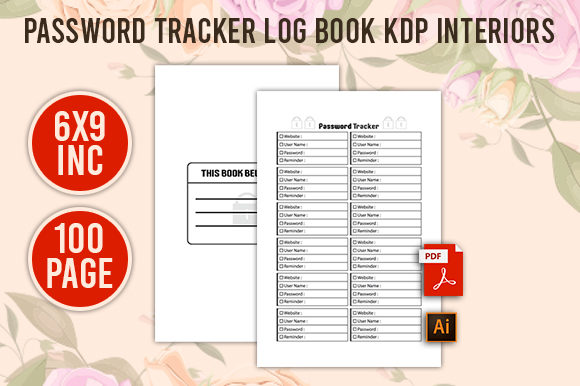
Creating a successful low-content book on Amazon requires more than just a catchy cover; the interior experience determines whether a customer leaves a five-star review or returns the product. Password Tracker KDP Interiors Vol- 2 addresses this critical quality gap by providing a comprehensive, professionally designed template specifically for password logbooks. This resource is not merely a collection of blank lines but a structured, high-resolution layout designed to meet the exacting technical standards of modern print-on-demand publishing. For sellers navigating the competitive landscape of digital organization tools, having a reliable, tested foundation allows for faster publication cycles and higher customer satisfaction.
Technical Specifications That Ensure Print Quality
The primary anxiety for any KDP publisher is receiving proof copies with blurry text, incorrect margins, or color shifts. Password Tracker KDP Interiors Vol- 2 mitigates these risks through rigorous technical adherence. The files are provided in CMYK color mode at 300 DPI, which is the industry standard for crisp, professional printing. Unlike RGB files that can look vibrant on screen but dull on paper, these interiors are calibrated for physical ink application.
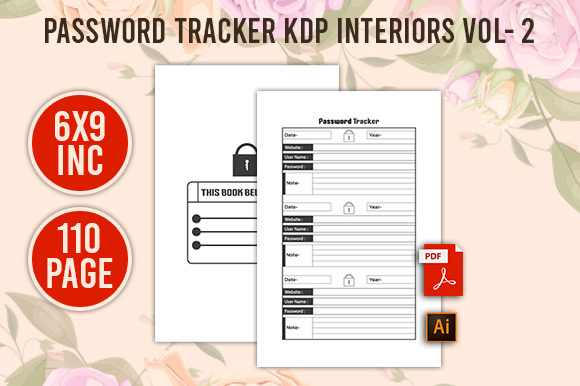
The dimensions are set to the popular 6x9 inch trim size, containing 110 pages of content. Crucially, the design accounts for "no bleed" requirements, ensuring that all functional elements remain safely within the printable area regardless of minor manufacturing variances. The inclusion of both an Adobe Illustrator (.ai) source file and a print-ready PDF offers flexibility. Publishers who want to publish immediately can use the PDF, while those wishing to customize fonts, add branding, or modify table structures can utilize the vector-based AI file without losing resolution.
Different Priorities for Different Publishers
While the asset itself remains constant, its value proposition shifts depending on where you are in your publishing journey. Understanding these nuances helps determine if this specific volume aligns with your current business objectives.
Beginners and Hobbyists: Reducing the Learning Curve
For those new to self-publishing, the technical aspects of book formatting can be paralyzing. Beginners often struggle with gutter margins, spine width calculations, and bleed settings. For this group, Password Tracker KDP Interiors Vol- 2 serves as an educational tool as much as a commercial asset. By examining a KDP-tested file, new publishers can reverse-engineer best practices. They can see exactly how much safe space is needed near the binding or how headers should be positioned for readability. The immediate benefit is speed; instead of spending weeks learning InDesign or Illustrator from scratch, a beginner can upload a compliant file and focus their energy on keyword research and cover design.
Professional Sellers and Agencies: Scaling Operations
Experienced KDP sellers operate on volume and efficiency. For professionals managing multiple niches or running a publishing agency, time is the most expensive resource. Creating a unique, high-quality interior from scratch for every new password tracker listing is rarely cost-effective. This volume acts as a scalable infrastructure component. Because it includes the editable AI file, agencies can quickly rebrand the interior to match different cover aesthetics or niche-specific themes without redesigning the core functionality. The fact that it is pre-tested reduces the rejection rate during the KDP review process, preventing costly delays in launch schedules.
Educators and Freelancers: Niche Customization
Freelancers and educators often create resources for specific communities rather than the mass market. A password tracker intended for seniors needs larger fonts and simpler layouts than one designed for tech-savvy millennials. Similarly, a freelancer creating client welcome packets might need a branded password keeper. The editability of this interior allows for targeted adaptation. An educator could modify the prompts to teach digital hygiene, while a freelancer could add their logo and contact information to the footer. Here, the priority is not just speed, but the ability to maintain professional consistency across diverse projects without hiring a graphic designer.
Evaluating Usability and Customer Experience
Ultimately, the success of a password tracker depends on the end-user. If the interior is frustrating to write in, the book will fail regardless of how beautiful the cover is. When evaluating Password Tracker KDP Interiors Vol- 2, consider the practical ergonomics of the layout.
- Writing Space: Does each entry provide adequate room for long URLs, complex usernames, and security questions? Cramped tables lead to messy books and poor reviews.
- Organization: Are there alphabetical tabs or index sections? Users need to retrieve information quickly, especially in emergency situations.
- Privacy Features: Does the design include space for notes or encryption keys without making the page feel cluttered?
- Bleed Safety: Is there sufficient white space near the gutter so users don’t have to break the spine to read what they wrote?
This volume has been KDP tested, which suggests these ergonomic factors were considered during the design phase. However, publishers should always order a physical proof to verify that the tactile experience matches their target audience's expectations.
Commercial Value Versus Creative Control
A common debate in the KDP community involves the trade-off between using pre-made interiors and creating custom ones. Pre-made assets like this offer undeniable commercial advantages: lower upfront costs, faster time-to-market, and verified technical compliance. For a saturated niche like password trackers, these efficiencies can be the difference between profitability and loss.
However, creative control remains paramount for long-term brand building. Relying solely on stock interiors can lead to marketplace saturation where multiple books share identical insides. The inclusion of the Adobe Illustrator source file bridges this gap. It encourages publishers to treat the template as a starting point rather than a final destination. Changing typefaces, adjusting column widths, or adding unique decorative elements transforms a generic asset into a proprietary product. This hybrid approach satisfies the need for speed while preserving the uniqueness that drives organic sales.
Making the Right Decision for Your Project
Determining whether Password Tracker KDP Interiors Vol- 2 is the right fit requires honest self-assessment. If your goal is to learn the fundamentals of book layout, this asset provides a flawless reference model. If you are scaling a publishing business and need reliable, compliant templates to reduce production bottlenecks, it offers significant ROI. If you require a highly specialized layout for a unique niche (e.g., a password tracker specifically for medical devices or cryptocurrency hardware wallets), you may still need to perform substantial edits or create a custom design.
Consider your technical proficiency as well. While the PDF is ready for immediate upload, leveraging the AI file requires access to and knowledge of Adobe Illustrator. If you lack this software or skill set, you are limited to the static PDF version. Conversely, if you possess design skills, the source file unlocks exponential value. Always weigh the cost of the asset against the hours of labor it saves. For many publishers, the investment in a high-resolution, KDP-tested interior pays for itself after selling just a few copies, making it a pragmatic choice for both serious entrepreneurs and casual creators looking to maintain quality standards in a demanding marketplace.